
Pay transparency software helps employers meet the EU Pay Transparency Directive: reporting pay gaps, answering employee pay requests and acting when a gap appears. New tools are launching every month, and most now automate the report. So this comparison focuses on what separates them. It includes our own tool, Bridgit Pay, and says where others might be the better fit.
We know the hardest part of the Directive to solve will be Article 10: closing gaps. If any category of workers shows a gender pay gap of 5% or more that you cannot justify with objective, gender-neutral criteria, you have six months to fix it. Otherwise you must carry out a joint pay assessment with worker representatives. Finding that gap is the easy part. Understanding why it exists and closing it within six months is where tools differ most. So choose your pay transparency software for what comes after the report.
Pay transparency software at a glance
| Tool | Type | Key strength | Best for |
|---|---|---|---|
| beqom | Compensation and performance suite | Compensation, benefits, performance management and budget planning in one system | Replacing most of your pay and reward systems with one platform |
| Syndio | Enterprise pay equity | Strong governance, integrations and statistical depth | Large employers with US and EU obligations and in-house analysts |
| Trusaic | Enterprise pay equity | Reporting across multiple jurisdictions | US-headquartered multinationals |
| Compensation IQ | Benchmarking-led | Salary benchmarking, job levelling against external frameworks, 50+ HRIS integrations | Teams whose first question is what to pay |
| Figures | Benchmarking-led | Benchmarking, budgets and manager collaboration | Setting pay ranges and planning pay budgets |
| Sysarb | Directive specialist | Job architecture, collaboration tools and manager and employee dashboards | Building job architecture inside the tool |
| PayGap | Directive specialist | Focused compliance analysis with advisory support | Teams who want expert advisers alongside the software |
| Bridgit Pay | Directive specialist | Full Directive compliance, results anyone can understand, and guided dashboards that show you what to do next | Closing pay gaps and building fairer pay across the organisation |
Want to close gaps as well as report them? Bridgit Pay covers every Directive requirement, shows why each gap exists, and gives HR and managers the tools to close it. See how Bridgit Pay works below, or book a demo.
What is pay transparency software?
Pay transparency software takes your payroll data and produces what the law requires: pay gap reports, answers to employee pay requests and evidence for any gaps you need to justify. The better tools also show why gaps exist and track the actions taken to close them.
Why closing a pay gap is the hard part of pay transparency
Most employers plan for the first report. Few plan for what happens when a category of workers shows a gap above 5%. That is when the real work starts, and six months goes quickly.
A gap has more than one cause. Part of it usually comes from representation: who is hired and promoted into which roles. Part comes from pay decisions within the same group. Each needs a different fix, and a single percentage does not tell you which you are dealing with.
Justifying a gap needs evidence. Under Article 18, the burden of proof sits with the employer. You need to show that a gap rests on objective, gender-neutral criteria, and keep the records to prove it.
The decisions sit with managers. Starting salaries, promotions, bonuses and pay rises are decided across the organisation. HR cannot close a gap alone.
Six months is roughly one pay cycle. If remedying a gap needs budget, approvals and a pay review, there is little time to spare.
Employees will ask. Once people can request pay information under Article 7, a gap you have not explained becomes a conversation you have not prepared for.
That is why the tool you start with matters. Switching after your first report means rebuilding data mappings and categories in the middle of the six-month window. Pick software that does the compliance and helps with what comes next, from the start.
Pay transparency software compared by type
Enterprise pay equity software: beqom, Syndio, Trusaic
These are mature platforms for large multinationals. beqom (which acquired PayAnalytics) is a full compensation and performance management suite, covering pay equity alongside salary review, budget planning and performance management, with pre-built EU templates and a pay transparency statement in all EU languages. Syndio stands out for governance and integrations, generates Article 7 reports in any EU language and maps pay policies for Article 6. Its approach is statistics-heavy. Trusaic covers reporting across multiple jurisdictions and suits US-headquartered employers. Its EU Directive tools look less developed than its US pay equity offering, and some of its AI features are listed as coming soon.
Best for: beqom if you want to replace most of your compensation, benefits and performance systems with one platform. Syndio or Trusaic if you have US and EU obligations and in-house analysts to run them.
Watch for: cost, time to go live and ease of use. On G2, reviewers of beqom's compensation suite report an average implementation time of 9 months and rate its cost in the highest band. Syndio and Trusaic are built around statistical analysis, which suits specialists more than everyday HR users or managers. Neither publishes implementation times, so ask for a realistic go-live date in writing.
Benchmarking-led tools: Compensation IQ, Figures
These started with salary data and added the Directive. Compensation IQ (London) offers salary benchmarking and job levelling, mapping your roles to external frameworks such as Mercer, Korn Ferry and Willis Towers Watson. Its EU module covers adjusted and unadjusted gaps, the seven Article 9 indicators, automated Article 7 responses and a flag when gaps approach 5%, and it lists 50+ HRIS integrations. Figures combines benchmarking with pay bands, budget planning and collaboration with managers, and lets you build remediation plans.
Best for: organisations whose first question is what to pay, and Figures in particular if you want managers involved in pay budgets.
Watch for: less public detail on Article 10. Flagging a gap is the start, and you still need to explain and remedy it within six months. Job levelling also needs care: in some countries, how jobs are evaluated and grouped must be agreed with worker representatives.
EU Directive specialists: Sysarb, PayGap, Bridgit Pay
Sysarb (Sweden) is built around the Directive, with job evaluation and architecture, pay ranges, collaboration tools, actions, manager and employee dashboards and ISO 27001. PayGap (Copenhagen) is compliance-driven, with adjusted pay gap analysis, individual case management that flags under- and overpaid employees, and new-hire salary tools. Its support leans heavily on expert advisers, and it is ISO 27001:2022 certified.
Best for: Sysarb if you need to build job architecture inside the tool. PayGap if you want expert advisers working alongside the software.
Watch for: Sysarb's dashboards leave managers and employees to find and interpret the data themselves. PayGap is focused on compliance, with few extras. Beyond new-hire salary tools and outlier alerts, its pages show little for closing gaps across the organisation, such as action plans with owners or manager involvement. It also sells expert hours in support tiers, so check how much adviser time you will need and what it costs over several years. Neither publishes implementation times.
Bridgit Pay is covered in detail below.
HR and payroll systems: SAP, Workday and others
If your HR platform has a pay equity module, check three things: whether it calculates the gap by category of worker under Article 9(1)(g), whether it handles Article 7 requests, and whether it applies each country's own rules. Calculations differ between countries, so a one-size-fits-all report may not be compliant everywhere. Many HR systems produce a dashboard and stop there. Specialist pay transparency software can sit alongside your HRIS.
Consultancies
A consultancy brings judgement, and is often the right partner for gender-neutral job evaluation. The trade-off is that the analysis usually arrives as a report, and next year you pay for the same calculations again. Many employers combine the two: software for the repeatable work, and expert help for the judgement calls.
Bridgit Pay: pay transparency software for closing gaps
I set up Bridgit Pay after interviewing HR and reward professionals. Their biggest problem was what to do after the report. As an occupational psychologist, I see closing a pay gap as a behaviour change problem as much as a data problem, so Bridgit Pay is built around four things.
1. Anyone in HR can pick it up
You do not need a statistician, reward analyst or consultant. Upload your payroll data and Bridgit Pay cleans it, runs the calculations and explains the results in plain language, with the report, root causes and action plan in one place. With clean data, smaller employers see their first results within an hour, mid-sized organisations within three days and large multi-country groups within a week.
“It saved us several days of work, completing complex calculations in seconds.”
- Cara, HR Director, TMF
2. It explains why the gap exists
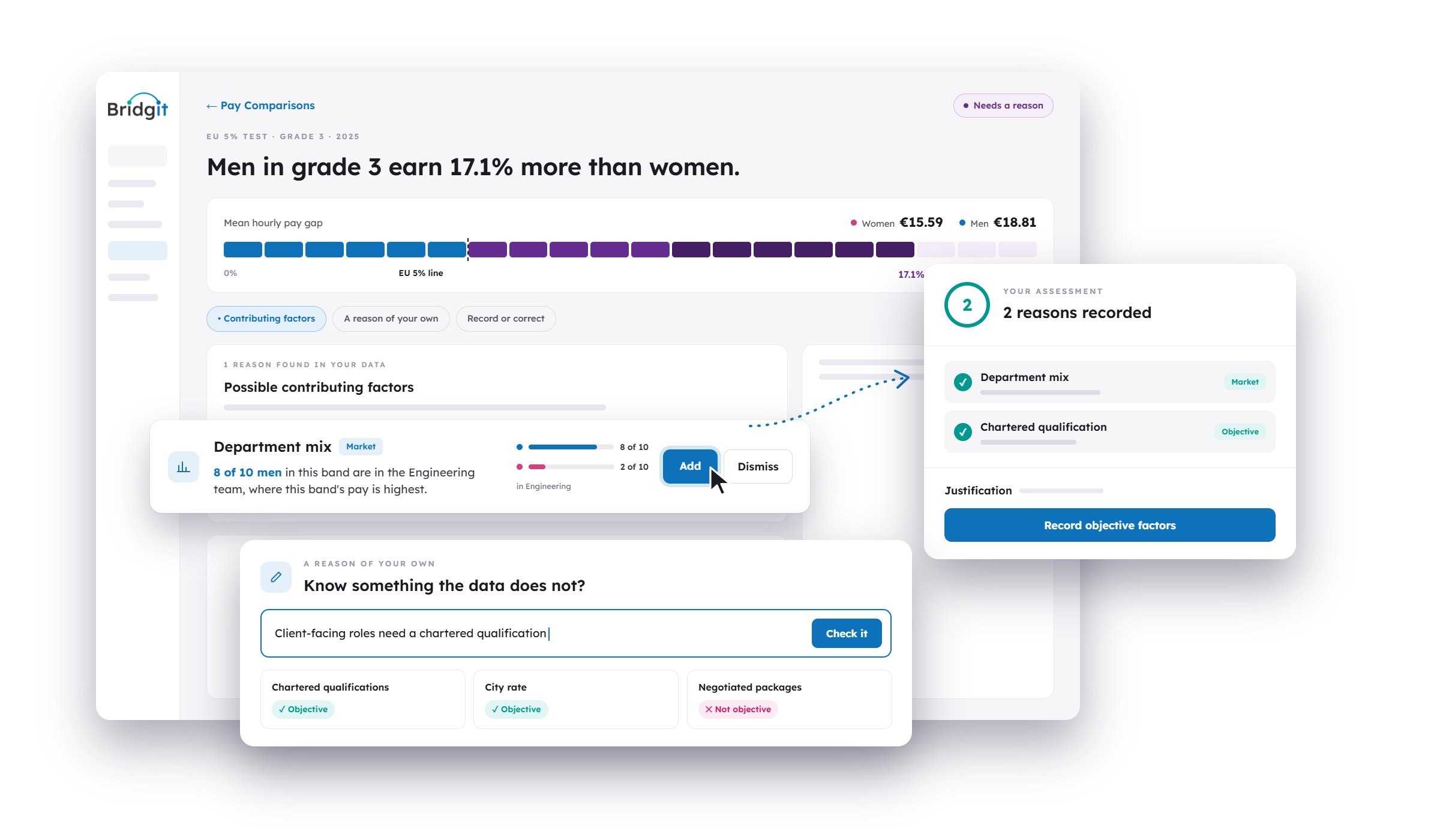
A 5% flag tells you there is a problem. Bridgit Pay's root cause analysis tells you what kind, splitting each gap into representation (who is in which roles and levels) and pay within the same group. One needs changes to hiring and promotion, the other to pay decisions. Adjusted and unadjusted gaps sit side by side.
For Article 10, AI-assisted objective reasoning lists the factors that could explain each gap, such as level or length of service, flags which count as objective and gender-neutral, and lets you check your own justifications against the EU framework. Justification tracking keeps the evidence, and a gap that cannot be justified moves straight into an action plan, well inside the six-month window.
3. It turns the analysis into action
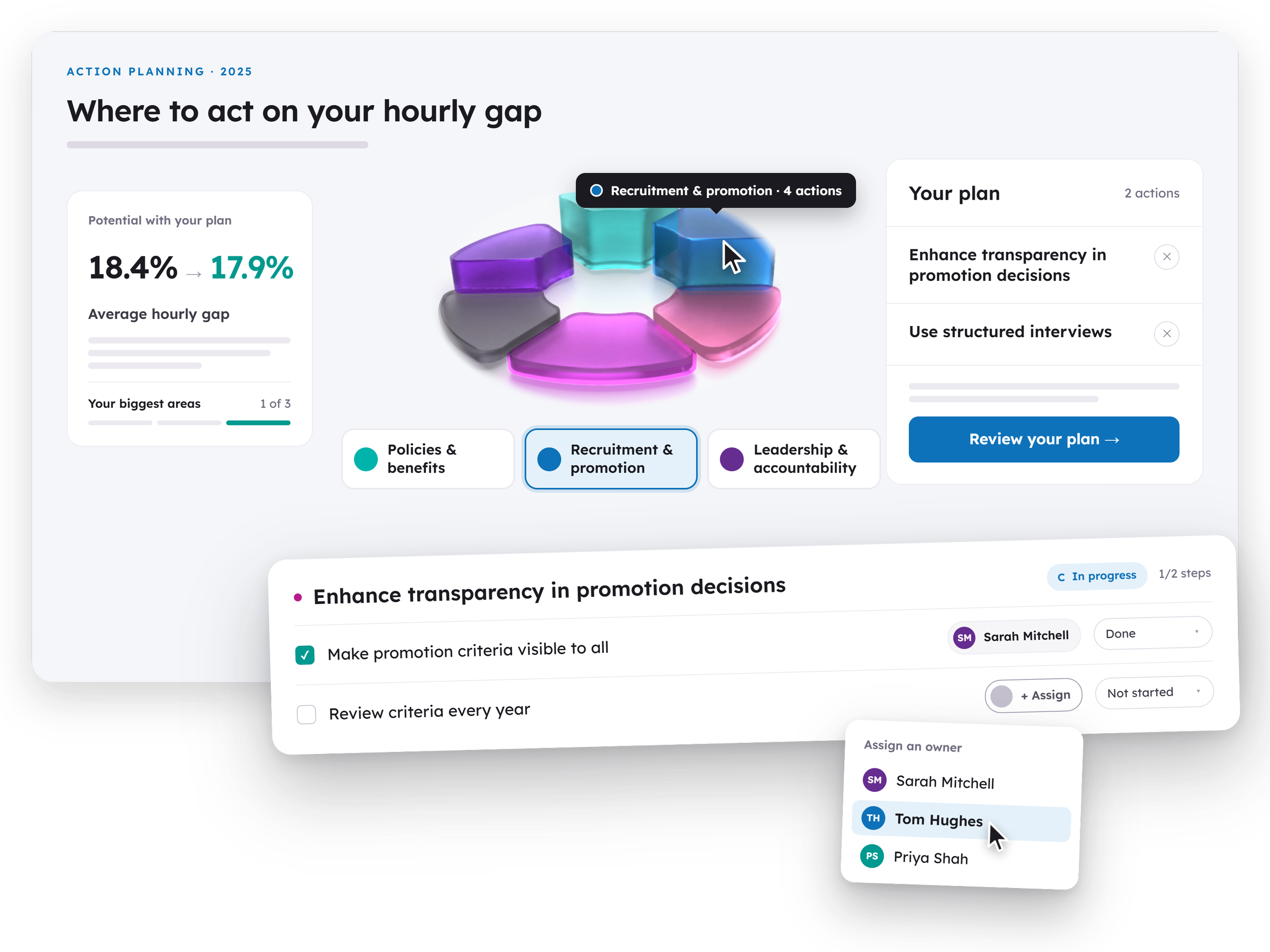
Smart action planning suggests actions based on what is driving each gap, drawing on six research-based areas where people can influence pay. Each action has a named owner, reminders and a deadline, so progress does not depend on one person in HR.
4. It creates visibility across the organisation
Most pay decisions are made by managers, who rarely see their effect. Bridgit Pay gives each manager a view of their own area and sends them their findings and actions with reminders, so they do not have to go looking for the data. For a central reward team, this is how action happens across hundreds of managers: make the problem visible, give people ownership, and keep it on their radar.
“We were able to explore pay gaps across lots of different factors which we had not previously been able to do”.
- Senior Pay and Reward Analyst, Pret a Manger
How does Bridgit Pay cover compliance?
Data: AI-assisted cleaning of each country's payroll, with every decision logged.
Article 9: pay gaps by category of worker across all 27 member states, applying national rules as each country transposes.
Article 4: job comparisons across your categories of workers, for equal work and work of equal value. Our partners can help with gender-neutral job evaluation.
Article 7: an employee request portal with communications built in, linked to your action plan, so HR has time to prepare a response.
Responsible AI: guardrails that check for and correct the inequalities AI can learn from the data it was built from. Read our blog on why AI can't do your gender pay gap report.
Security: ICO-registered, collecting only the data needed, and built on infrastructure from providers certified to ISO 27001.
Where Bridgit Pay is not the right fit
We do not run gender-neutral job evaluation. Our partners do, and Sysarb and Compensation IQ offer job architecture tools.
If you want to replace your full suite of HR or reward software in one go, Bridgit Pay is not the right fit. We specialise in the EU Pay Transparency Directive and closing pay gaps, and work with your current systems, so there is no large implementation project. For an all-in-one compensation suite, look at beqom.
Pricing: from £865 / €995 a month, including the EU baseline and one country, with extra countries from £215 / €245 a month. See Bridgit Pay’s Pricing.
How to choose pay transparency software: the five jobs it has to do
Every tool above claims Directive compliance. The differences show up when you ask how each one handles these five jobs.
| Job | Why it is hard | Ask the vendor |
|---|---|---|
| 1. Get the data right | Payroll exports from different countries use different pay codes. Bonuses, allowances and benefits in kind need mapping before any gap is reliable. | Who cleans the data, and can I see every decision made about it? |
| 2. Build categories of workers | Article 4 needs equal value comparisons across different jobs, which most employers have never done. | Do you build categories, or work with ones from our job evaluation? |
| 3. Report the gap | Seven indicators, per entity, per country, on national timelines. | Which countries have you built rules for? |
| 4. Explain and close gaps | A 5% gap starts a six-month clock. A number alone does not tell you whether it comes from who you hire and promote, or from what you pay them. | What does the platform tell me about why the gap exists, and who acts on it? |
| 5. Answer employee requests | Requests need identity checks, accurate category averages, a reply within the national deadline and, often, a careful explanation of any gap. | What happens between a request arriving and the reply going out, and how do we prepare the message? |
What the EU Pay Transparency Directive requires
Directive (EU) 2023/970 had to be written into national law by 7 June 2026. Countries are at different stages, and some go further than the Directive. Visit Bridgit Pay’s EU Pay Transparency Tracker. These are the articles pay transparency software has to support.
| Article | Requirement | In practice |
|---|---|---|
| Article 4 | Pay structures that compare equal work and work of equal value using objective, gender-neutral criteria: skills, effort, responsibility and working conditions. | You need defensible categories of workers. |
| Article 5 | Starting pay or a pay range for applicants. No pay history questions. | You need bands you can stand behind. |
| Article 6 | Workers can see the criteria for pay, pay levels and progression. | You need written, consistent pay criteria. |
| Article 7 | Workers can request their pay level and average pay by sex for their category. Reply within two months. Remind workers of the right every year. | You need a way to verify, answer and track requests. |
| Article 9 | 150+ employees report by 7 June 2027. 250+ then report every year, 150 to 249 every three years. 100 to 149 start by 7 June 2031. | Seven indicators, including the gap by category of worker. |
| Article 10 | A joint pay assessment if a category shows a gap of 5% or more that is not justified by objective, gender-neutral criteria and not remedied within six months. | You need to explain each gap, then act on it, fast. |
National rules can be stricter. Malta, for example, sets a much shorter reply window for employee requests than two months.
Pay transparency in-house: what it really involves
Doing it in-house, with a spreadsheet or an analyst, can work for one country with a few hundred people and clean data. Beyond that, it means cleaning payroll data from every country, calculating seven indicators per category of worker under each country's rules, answering Article 7 requests all year with an audit trail, and relying on one or two people who know the method. Every week spent on calculations is a week not spent closing gaps.
How we compared these tools
Bridgit Pay publishes this comparison, so we have tried to make it easy to check. Every tool was assessed against the articles of the Directive and the five jobs above, using what each vendor publishes. Comments on ease of use and approach reflect my own review of each vendor's website and product materials in October 2026. Sources are linked at the end, and the information is correct as of the date at the top of this page. If you spot something out of date, let us know.
Pay transparency software FAQs
How much does pay transparency software cost?
Most vendors do not publish prices, and enterprise tools are usually quoted per employee. Of the tools here, Bridgit Pay publishes full pricing (we work in pay transparency, so how could we not be transparent about pay!), PayGap publishes support tiers, and Compensation IQ publishes some prices. Bridgit Pay starts from £865 / €995 a month.
How long does it take to implement pay transparency software?
It varies widely. G2 reviewers report an average of 9 months to implement beqom's compensation suite. Compensation IQ says customers go from data to compliance in about six weeks. With Bridgit Pay, smaller employers see their first results within an hour, mid-sized organisations within three days, and large multi-country groups within a week, once they have provided their data. The biggest factor is usually data quality. With first reports due by 7 June 2027 on 2026 pay data, allow time to clean your data, confirm your categories of workers and review any gap above 5% before you publish.
What happens if our pay gap is over 5%?
If a category of workers shows a gap of 5% or more that you cannot justify with objective, gender-neutral criteria, and you do not remedy it within six months of reporting, you must carry out a joint pay assessment with worker representatives under Article 10.
When do EU employers have to report their pay gap?
Under the Directive, employers with 150 or more employees report by 7 June 2027, based on 2026 pay data. Employers with 100 to 149 employees start by 7 June 2031. Check national law, as dates and thresholds vary. See Bridgit Pay’s EUPTD tracker.
Does the EU Pay Transparency Directive apply to UK employers?
The UK has not adopted it. UK companies with employees in EU member states must comply for those employees.
Can our HR system handle pay transparency?
Check three things: whether it reports the gap by category of worker, whether it handles Article 7 requests, and whether it applies each country’s own rules. Calculations differ between countries, so a one-size-fits-all report may not be compliant everywhere. If it falls short on any of these, you will need specialist pay transparency software or a manual process.
Close your pay gaps before the six months run out
Bridgit Pay handles the compliance and helps your HR team and managers close the gaps it finds. Book a demo to see it with your own data, or start with our 1.5-hour EU Pay Transparency readiness workshop.
Sources
Vendor information is from these public pages on 27 October 2026.
• Directive (EU) 2023/970, EUR-Lex
• beqom: acquisition of PayAnalytics
• Syndio: EU Pay Transparency Directive
• Trusaic: preparing for the Directive
• Sysarb